Wednesday, January 6, 2010

People work on damaged houses on a street of the historical Brazilian city of Sao Luiz do Paraitinga


05 Jan 2010
Source: Reuters
People work on damaged houses on a street of the historical Brazilian city of Sao Luiz do Paraitinga, 170 km (106 miles) north of Sao Paulo January 5, 2010. At least 76 people have died in flooding and mudslides in Brazil's three largest states over the past four days, according to police officers. REUTERS/Roosevelt Cassio (BRAZIL - Tags: DISASTER ENVIRONMENT)

Wednesday, December 30, 2009

AFRICA: Drying, Drying, Disappearing…


AFRICA: Drying, Drying, Disappearing…
Source: Inter Press Service
Reuters and AlertNet are not responsible for the content of this article or for any external internet sites. The views expressed are the author's alone.

By Paul VirgoROME, Dec 26 (IPS) - Lake Chad was bigger than Israel less than 50 years ago. Today its surface area is les than a tenth of its earlier size, amid forecasts the lake could disappear altogether within 20 years. Climate change and overuse have put one of Africa's mightiest lakes in mortal danger, and the livelihoods of the 30 million people who depend on its waters is hanging by a thread as a result.An unprecedented crisis is looming that would create fresh hunger in a region already suffering grave food insecurity, and pose a massive threat to peace and stability, experts say."If Lake Chad dries up, 30 million people will have no means of a livelihood, and that is a big security problem because of growing competition for smaller quantities of water," Dr Abdullahi Umar Ganduje, executive secretary of the Lake Chad Basin Commission (LCBC) tells IPS in Rome."Poverty and hunger will increase. When there is no food to eat, there is bound to be violence."The lake, which shrank 90 percent between 1963 and 2001 from 25,000 square kilometres to under 1,500, is bordered by Chad, Niger, Cameroon and Nigeria.

Tuesday, December 22, 2009

Kenderaan


1. Pada setiap hari perjalanan hidup kita apakah kenderaan yang kita naiki. Apakah kenderaan itu kereta, kapalterbang, kapal, kuda atau segala macam jenis pengangkutan laut darat juga udara.
2. Itu semua memanglah kenderaan diatas dunia ini. Tapi bila kita mati kenderaan ini akan diwarisi. Tapi apakah kenderaan yang kita sentiasa naiki siang malam samada tidur jaga, pengsan, sakit, susah senang selama 24 jam tanpa henti.
3. Pada hakikatnya UMUR kita itulah kenderaan kita yang sebenarnya. Jika 40 tahun umur kita bermakna sudah jauh perjalanan kita yang dibawa oleh umur tersebut. Kenderaan ini tidak akan berpatah balik dimana ia datang. Ia akan sentiasa ketempat tujuannya iaitu KUBUR. Bila kita mati maka kenderaan (umur) tadi pun tidak akan membawa kita kemana-mana lagi tempat didunia ini. Kerana tempat persinggahan terakhir umur kita ialah kubur. Jadi gunakan kenderaan ini dengan sebaik-baiknya semasa ia masih ada untuk ketempat-tempat yang diredhai oleh ALLAH SWT sebelum ia sampai ke kubur. Bila kita mati kenderaan (umur) lain pula yang akan membawa kita. Kenderaan itu akan kekal untuk selama-lamanya. Jika baik balasan maka berbahagia dan begitulah sebaliknya.

Saturday, December 12, 2009

Climate change and freshwater part 3…rising sea levels and island nations at risk


Since the mid to late 1800’s sea levels have been very slowly rising…about 1 cm a year which is so small who would notice? It’s now been about a century and some change and the rate of rising is starting to accelerate to about 2 cm a year. The tiny changes over the years are becoming noticeable. Sea levels are rising and we are learning that in the last decade alone the rate is up to about 3cm a year.The threat of rising sea levels to our coastal cities is being felt around the world such as the magnificent historical city of Venice, Italy…a place on my “bucket list” [the list of things you want to see and do before you die or "kick the bucket" in American slang]. Poor Venice has a double whammy of both slowly sinking as a result of its own weight on the barrier islands it was constructed upon and a rising Adriatic Sea. Venice is not alone..more than half of the world’s population lives within 60 Kilometers [36 miles] of the coast and the effects of a rising sea and retreating coastline is a serious issue for all of us. I’m not going to be focusing on coastal effects here, instead this post is the warm up to the issue of freshwater and island nations. As you’ve hopefully read in my previous posts I believe that islands hold lessons for the rest of us on the mainlands. Islands are the “Miner’s Canary” for us and when island nations start running into issues, in this case sea levels and freshwater, we need to pay attention.

Rising seas threaten 20 million in Bangladesh


11 Dec 2009 13:39:37 GMT
Source: Reuters
DHAKA, Dec 11 (Reuters) - Rising sea levels, triggered by global warming, will displace about 20 million people in low-lying Bangladesh, a study by a state-run think-tank said on Friday.

"The sea level will rise at least by three metres (yards) submerging some 18 percent of the country by 2050," the Dhaka-based Institute of Water Modelling (IWM) said.

IWM was set up in 1996 for planning and management of Bangladesh's water resources and to monitor rise in sea level and its probable adverse effects.

Bangladesh would need $4.16 billion for building embankments and forestation to secure inhabitants from rising seas, the think- tank said.

"Only embankments with deep forestation along the coast and coastal rivers can protect millions of people," it said.

The existing embankments should be raised up to six metres to protect the coastal villages from being devoured by sea, the study said.

Bangladesh has said it would need $10 billion from big polluting nations to help it adapt to powerful storms, floods and rising seas.

Thursday, December 3, 2009

RNPS IMAGES OF THE YEAR 2009 03 Dec 2009 Source: Reuters

RNPS IMAGES OF THE YEAR 2009 - A policeman walks past the body of a man, who was killed by a stray bullet when the funeral procession for Reverend Gerard Jean-Juste was broken up by gunshots, in front of the national palace in Port-au-Prince June 18, 2009. The funeral procession for Jean-Juste, an ally of Haiti's former president Jean-Bertrand Aristide, was broken up by gunshots from U.N. soldiers and at least one person was killed by stray bullets, according to witnesses. The U.N. has yet to make a statement on this incident. REUTERS/St Felix Evens (HAITI POLITICS OBITUARY CONFLICT IMAGES OF THE DAY)
REUTERS/STR

People look at the wreckage of a bus after a blast ripped through it in Sayyedeh Zeinab, near Damascus 03 Dec 2009 Source: Reuters

People look at the wreckage of a bus after a blast ripped through it in Sayyedeh Zeinab, near Damascus, December 3, 2009. The blast ripped through a bus carrying Iranian pilgrims on Thursday, killing at least three people in an incident Syria said was an accident and not a terrorist attack. REUTERS/Khaled al-Hariri (SYRIA POLITICS CONFLICT DISASTER)
REUTERS/KHALED AL-HARIRI

REUTERS PICTURES OF THE DECADE


REUTERS PICTURES OF THE DECADE. A Georgian man cries as he holds the body of his relative after a bombardment in Gori, 80 km (50 miles) from Tbilisi, August 9, 2008. A Russian warplane dropped a bomb on an apartment block in Gori on Saturday, killing at least 5 people, a Reuters reporter said. The bomb hit the five-story building close to Georgia's embattled breakaway province of South Ossetia when Russian warplanes carried out a raid against military targets around the town. REUTERS/Gleb Garanich (GEORGIA)
REUTERS/GLEB GARANICH

Fourteen-month-old Yabila Kubemboli


Fourteen-month-old Yabila Kubemboli, who is malnourished after his mother fled attacks on her village by Ugandan Lord's Resistance Army (LRA) rebels, awaits treatment at the hospital in the village of Dungu in northeastern Congo, February 20, 2009. (REUTERS/Finbarr O'Reilly) #

Wednesday, December 2, 2009

RNPS IMAGES OF THE YEAR 2009


RNPS IMAGES OF THE YEAR 2009 - Six-year-old Sara Luce and her mother eat as they rest outdoors after an earthquake caused the collapse of St. Salvatore Hospital in Aquila April 6, 2009. A powerful earthquake struck a swathe of central Italy as residents slept on Monday morning, killing more than 90 people and flattening whole towns. REUTERS/Giampiero Sposito (ITALY DISASTER HEALTH IMAGE OF THE DAY TOP PICTURE)
REUTERS/GIAMPIERO SPOSITO

RNPS IMAGES OF THE YEAR 2009

RNPS IMAGES OF THE YEAR 2009 - An injured girl cries during an evacuation after an earthquake hit Padang, Indonesia's Sumatra island September 30, 2009. A 7.6 magnitude earthquake struck off the city of Padang on Indonesia's Sumatra island on Wednesday, killing at least 75 people and trapping thousands under rubble, officials said. REUTERS/Muhammad Fitrah/Singgalang Newspaper (INDONESIA DISASTER ENVIRONMENT) QUALITY FROM SOURCE
REUTERS/STRINGER/INDONESIA

Chernobyl disaster

The Chornobyl disaster was a nuclear reactor accident that occurred on 26 April 1986 at the Chornobyl Nuclear Power Plant in Ukraine (then part of the Soviet Union). It is considered to be the worst nuclear power plant disaster in history and the only level 7 event on the International Nuclear Event Scale. It resulted in a severe release of radioactivity following a massive power excursion that destroyed the reactor. Most deaths from the accident were caused by radiation poisoning. On 26 April 1986 at 01:23 a.m. (UTC+3) reactor number four at the Chornobyl plant, near Prypiat in the Ukrainian Soviet Socialist Republic, exploded. Further explosions and the resulting fire sent a plume of highly radioactive fallout into the atmosphere and over an extensive geographical area. Four hundred times more fallout was released than had been by the atomic bombing of Hiroshima.[2]


From:

From Wikipedia, the free encyclopedia

Photo:
1. The nuclear reactor after the disaster. Reactor 4 (center). Turbine building (lower left). Reactor 3 (center right).
2. The abandoned city of Prypiat with Chornobyl plant in the distance.
3. Abandoned housing blocks in Prypiat.

Posted by Picasa

Monday, November 30, 2009

A woman mourns after her husband and son died in a ferry accident, by the bank of river Tetulia

A woman mourns after her husband and son died in a ferry accident, by the bank of river Tetulia, near Lalmohon town of Bhola district November 29, 2009. The death toll from an overcrowded ferry that sank in Bangladesh two days ago rose to 49, officials said on Sunday, with rescuers saying many more victims were still trapped trapped inside the vessel. REUTERS/Andrew Biraj (BANGLADESH TRANSPORT DISASTER)
REUTERS/ANDREW BIRAJ

The partially capsized ferry M.V. Coco-4 is seen it is re-floated by salvage vessel M.V. Hamza by the bank of river Tetulia, near Lalmohon town of Bhola district November 29, 2009. The death toll from the overcrowded ferry that sank in Bangladesh two days ago rose to 49, officials said on Sunday, with rescuers saying many more victims were still trapped trapped inside the vessel. REUTERS/Andrew Biraj (BANGLADESH)
REUTERS/ANDREW BIRAJ

Sunday, November 29, 2009

Saudi floods death toll rises to 98. Extremely Heavy Rain in Saudi Arabia


Source: Reuters
JEDDAH, Saudi Arabia, Nov 28 (Reuters) - The death toll from the heaviest rainfall to hit Saudi Arabia in years rose to 98 on Saturday as more bodies were recovered, with dozens more expected to be found, a rescue services spokesman said. The victims were drowned or were killed by collapsing bridges and in car crashes when floodwaters caused by the torrential rainfall ripped through the Red Sea port city of Jeddah on Wednesday. No pilgrims attending the annual Muslim haj pilgrimage 80 km (50 miles) away in Mecca were among the dead, officials have said. Jeddah is the main entry point to the kingdom for pilgrims. Hundreds had to be rescued after being stranded by the floods, with access to the city hampered after two bridges on the highway leading to Jeddah were destroyed. Newspapers have repeatedly reported on the poor condition of the sewerage infrastructure of the city, where many live in unauthorised developments built on dry riverbeds. About 1.6 million pilgrims have come to Saudi Arabia from abroad for the haj, the world's largest regular religious gathering. (Reporting by Souhail Karam; Writing by Raissa Kasolowsky) ((raissa.kasolowsky@thomsonreuters.com; Reuters Messaging: raissa.kasolowsky.reuters.com@reuters.net; +971 4 391 8031))
The incredible Autumn rainstorm brought extreme rainfall to Saudi Arabia. Rainfall from NASA TRMM website indicates rainfall around 100m over a large area of Saudi Arabia (mainly from Southern to Northern Saudi Arabia). The rainfall amounts probably exceeded 100m in some areas (see photos below). Rain also lashed Kuwait.
The rain was so heavy that it flooded many areas. Major cities affected include Makkah, Madina, Riyadh, Qassim, Hail, Abha, Jizan, and Jedda. The rainstorm forced many people to evacuate and caused several accidents. Read more about the heavy rain event from World Futurs and Arabian Business. Suprisingly enough, one of the oldest valleys (Rumma Valley) in the Arabian Peninsula have started flowing due to the persistent heavy rain and it’s moving northward. This is our Arabia River resurrected.


Posted by Picasa

Workers restore the Sayano-Shushenskaya hydroelectric power station near the Siberian village of Cheryomushki


A general view shows the Sayano-Shushenskaya hydroelectric power station near the Siberian village of Cheryomushki, about 520 km (323 miles) south of Krasnoyarsk, November 28, 2009. Repair work is currently taking place at the power station which halted power production after the August 17, 2009 accident when a turbine room in the station flooded, killing more than 70 people and causing billions of roubles of damage. REUTERS/Ilya Naymushin (RUSSIA ENERGY DISASTER)
REUTERS/ILYA NAYMUSHIN
Posted by Picasa

Saturday, November 28, 2009

REUTERS PICTURES OF THE DECADE


REUTERS PICTURES OF THE DECADE. A man holding a baby uncovers the body of a dead man, suspected to have been sitting there for two days, outside the New Orleans Convention Center September 1, 2005. Several people among the thousands of stranded hurricane evacuees died while waiting outside the building, with no sign of imminent help on the way. REUTERS/Rick Wilking (UNITED STATES) TEMPLATE OUT
REUTERS/RICK WILKING

Warming could bring fire and brimstone, tsunami and quake - scientists


LONDON (AlertNet)- Quakes, volcanic eruptions, giant landslides and tsunamis may become more frequent as global warming changes the earth's crust itself, scientists warned on Wednesday. Climate-linked geological changes could also trigger "methane burps" - the release of a potent greenhouse gas, currently stored in solid form under melting permafrost and the seabed, in quantities greater than all the carbon dioxide in our air today.

Friday, November 27, 2009

Floodwaters

Villagers wade through floodwaters in the village of Patia in Pandeglang, Banten province November 27, 2009. Indonesia has entered its rainy season although some regions in the vast archipelago still suffer from drought. REUTERS/Dadang Tri (INDONESIA SOCIETY ENVIRONMENT DISASTER)

Penduduk mengharungi banjir disebuah desa di Patia Pandeglang, Provinsi Banten November 27, 2009. Indonesia telah memasuki musim hujan meskipun beberapa daerah di kepulauan yang luas masih menderita musim kemarau. REUTERS / Dadang Tri ( PERKUMPULAN BENCANA ALAM SEKITAR INDONESIA)

REUTERS PICTURES OF THE DECADE


REUTERS PICTURES OF THE DECADE. A woman cries as she cannot find her four-year-old daughter and husband on the top of the ruins of a destroyed school in earthquake-hit Beichuan county, Sichuan province, May 17, 2008. REUTERS/Jason Lee (CHINA)
REUTERS/JASON LEE

REUTERS PICTURES OF THE DECADE. Seorang wanita menangis saat ia gagal menemui anak perempuan berusia empat tahun dan suaminya di atas runtuhan sekolah yang rusak akibat gempa Beichuan county, wilayah Sichuan, 17 Mei 2008. REUTERS / Jason Lee (CHINA)
REUTERS / JASON LEE

Tsunami


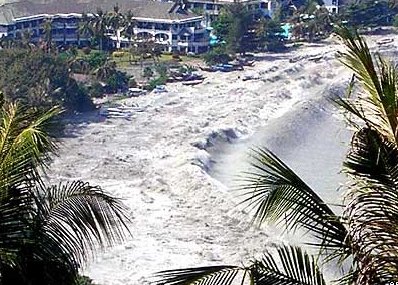
How fast do tsunamis travel?

Tsunami wave speed is controlled by water depth. Where the ocean is over 6,000 meters (3.7 miles) deep, unnoticed tsunami waves can travel at the speed of a commercial jet plane, over 800 km per hour (500 miles per hour). Tsunamis travel much slower in shallower coastal waters where their wave heights begin to increase dramatically.

Friday, November 20, 2009

Kehidupan Umpama Sebuah Keretapi


Kehidupan ini pada zahirnya dikawal oleh hukum sebab musabab. Hukum sebab musabab berjalan melalui makhluk, maka kelihatanlah tindakan makhluk mencorakkan berbagai-bagai keadaan dan peristiwa. Kehidupan ini adalah umpama sebuah keretapi. Pengalaman yang diharungi oleh seseorang menjadi batang-batang besi sambung menyambung membentuk landasan dan memaksa keretapi bergerak mengikut arah yang terbentuk. Keretapi tersebut bergerak mengheret gerabak-gerabak yang muatannya adalah berbagai-bagai anasir yang berkumpul dalam sistem sebab musabab, terdiri daripada berbagai-bagai jenis makhluk, memakai berbagai-bagai rupa dan nama. Semakin banyak sistem sebab musabab yang dikumpulkan semakin banyak juga makhluk yang mengenderai keretapi. Jika bahan yang dibawa terlalu banyak enjin keretapi tidak terdaya menarik gerabak-gerabak yang penuh dengan muatan itu. Keadaan ini memaksa keretapi berhenti kerana kehabisan tenaga. Tatkala itu semua bahan-bahan yang dimuatkan ke dalam gerabak keretapi perlu dinilai semula. Hasil daripada penilaian semula akan didapati banyak daripada muatannya adalah bahan yang tidak berguna. Sebahagiannya adalah sampah sarap dan sebahagian lagi benda-benda sisa buangan yang kotor dan menjijikkan.

Wednesday, November 11, 2009

4 Perkara Di Pohon Ketika Berdoa

1. Sewaktu hendak berdoa seelok-eloknya sebutlah nama. Contohnya jika berdoa untuk anak-anak maka sebut nama anak kita secara khusus bukan secara umum. Seperti Ya Allah berilah taufik dan hidayah kepada anakku Ahmad.
2. Begitu juga jika berdoa untuk diri sendiri juga sebutlah nama kita. Seperti Ya Allah kurniakan pada saya Abu.....(dengan menyebut nama sendiri).
3. Begitu juga biasanya bila berdoa mohon rezeki kita akan kata Ya Allah murahkanlah rezekiku. Adalah lebih baik dengan mengatakan berkatkan rezeki/perluaskan rezekiku. Memang maksud murahkan rezeki seolah-olah permudahkan dapat rezeki tapi kadang-kadang akan menjadi makna lain seperti dapat rumah murah, kereta murah dan lain-lain.
4. Doa yang dianjurkan Nabi saw antaranya ialah KAYA dengan ILMU
5. HIASI diri dengan sifat SABAR.
6. MULIA dengan TAQWA.
7. CANTIKKAN dengan KESIHATAN.

Saturday, October 31, 2009

Masalah dan Hikmahnya


1. Yang tiada masalah ialah orang gila dan orang yang telah mati. Tapi sebaliknya orang gila itu pula yang akan memberi masalah pada orang lain.
2. Jika miskin masalahnya kurang dari segi kewangan.
3. Jika kaya pula masalahnya ingin lagi menambah kekayaannya (tamak).
4. Jika sakit pula masalahnya berat menanggung bebannya dan jika sihat pula masalahnya ialah mempertahankan kesihatannya.
5. HIKMAHnya ALLAH SWT memberi masalah atau cubaan kepada manusia ialah kerana ingin mengampunkan dosa-dosa kecil kita. Dosa besar mesti bertaubat nasuha.
6. Ganjarannya jika DEMAM PANAS sehari dapat MENGAMPUN DOSA setahun
7. Syarat untuk diampunkan dosa ialah ianya masalah itu datang kepada kita bukan kita yang mencarinya. Contoh jika saja-saja menyeksa diri seperti mencucuk jarum kejari itu dikira merosakkan diri.
8. Lagi syarat untuk diampunkan dosa ialah mesti redha kepada masalah tersebut.
9. KISAH 3 orang makcik penjual kueh. Penjual 1 dan 2 adalah orang biasa dari segi ketaatan kepada ALLAH SWT. Penjual kueh ketiga pula orang yang amat taat. Mereka bertiga setiap pagi menaiki bas untuk berniaga.

Wednesday, October 14, 2009

Bila Doa Tidak terjawab

1. Kuliah disampaikan oleh KH Zainuddin MZ. Untuk mendengardisini klik disini

Friday, October 2, 2009

3000 tahun Neraka Di Nyalakan


1000 tahun neraka dinyalakan ia berwarna merah. Kemudian dinyalakan selama 1000 tahun lagi sehingga berwarna putih. Dan selama 1000 tahun dibakar sehingga berwarna hitam.